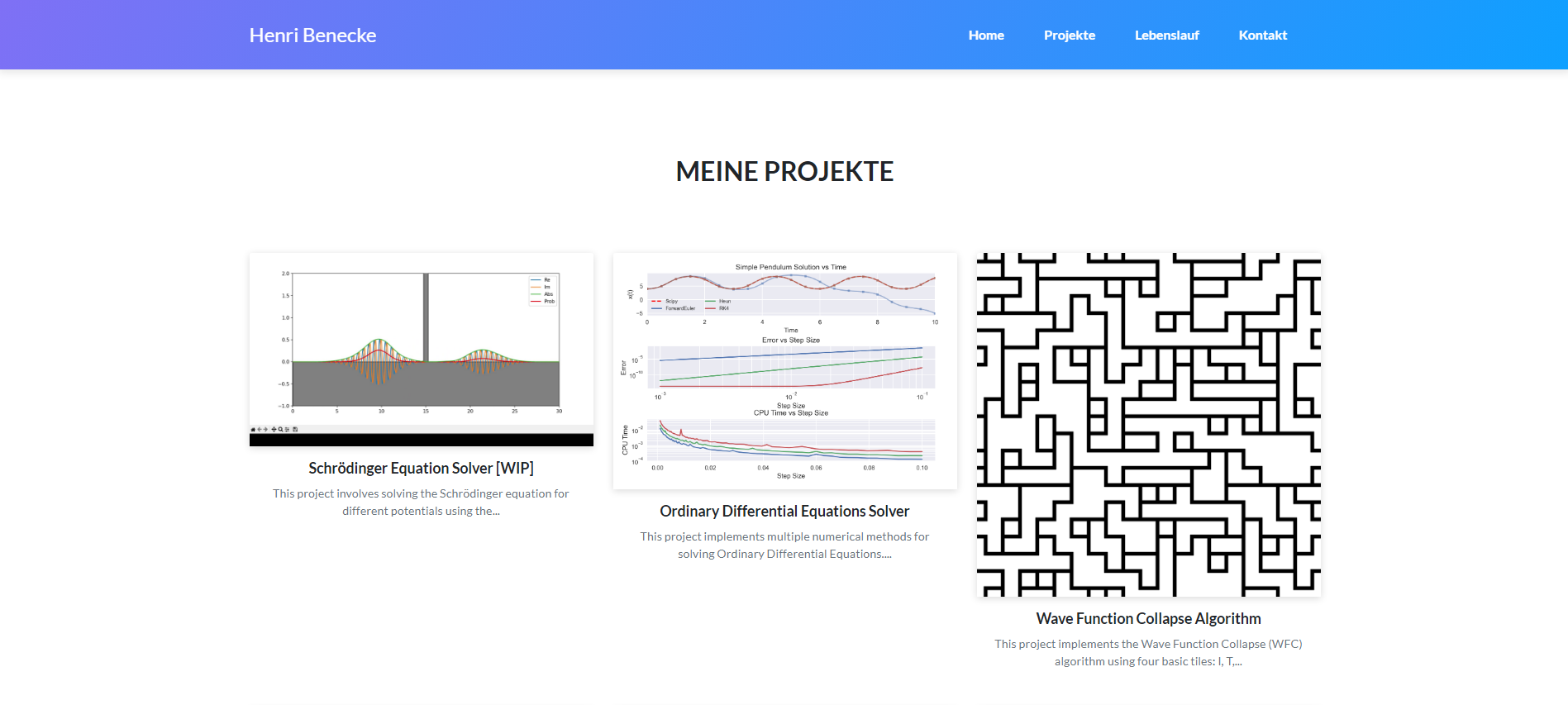
Schrödinger Equation Solver [WIP]
![Schrödinger Equation Solver [WIP]](../static/img/projects/SchroedingerEquationSolver.jpg)
Quantum Mechanic Simulator
Description
This is a simulator for quantum mechanics. It is still work in progress.
Goals
- Simulate a free particle
- Simulate a particle in a potential
- Infinite potential well
- Finite potential well
- Step potential
- Tunneling
- Harmonic oscillator
- Hydrogen atom
- 2D simulation
- Calculate the eigenvalues and eigenfunctions of a given potential and plot them
- Get a linear combination of eigenfunctions
- Time dependent Potential
- Save the animation as a video
- Implement a Terminal UI
Theory
Schrödinger's Equation
The Schrödinger's Equation is a partial differential equation that describes how the quantum state of a physical system evolves over time. It is defined as
i \hbar \frac{\partial}{\partial t} |\psi(t)\rangle = \hat{H} |\psi(t)\rangle
where \(\hat{H}\) is the Hamiltonian operator of the system. It is the sum of the kinetic energy and the potential energy of the system.
\hat{H} = \frac{\hat{p}^2}{2m} + V(\hat{x}) = -\frac{\hbar^2}{2m} \frac{\partial^2}{\partial x^2} + V(x)
Technologies used
- Python
- Numpy
- Matplotlib (for plotting/animate the results)
- Scipy (for efficient matrix operations and solving the linear system)
Challenges and Solutions
- Finding a starting point for the project:
- The runtime to calculate the results was too long (30s for 1000 time steps):
- First Problem was, that I transformed a Numpy array into a Scipy Sparse CSC matrix in every iteration. This was the biggest bottleneck. I solved this by transforming the Numpy array into a Scipy Sparse CSC matrix once and then using this matrix in every iteration. This reduced the runtime from 30s to 2.5s. (Improvement-factor: 12)
- The second problem was, that I used the 'sp.sparse.linalg.solve' function which is efficient for sparse matrices, but there is a more efficient algorithm for tridiagonal matrices. I transformed the matrix into a band matrix and solved the linear system with the ' sp.linalg.solve_banded'. This reduced the runtime from 2.5s to 1s. (Improvement-factor: 2.5)
- Both optimizations together reduced the runtime from 30s to 1s. (Improvement-factor: 30)
- Finding time to work on the project:
- Due to college I had to pause the project for a few months. The good thing is, that in the meantime I learned a lot about computational physics and numerical methods in college courses, which will definitely help me to improve the project.
Installation
How to use
Sources
More Projects