N-Body-Simulation
N-body Simulation with Barnes-Hut Algorithm
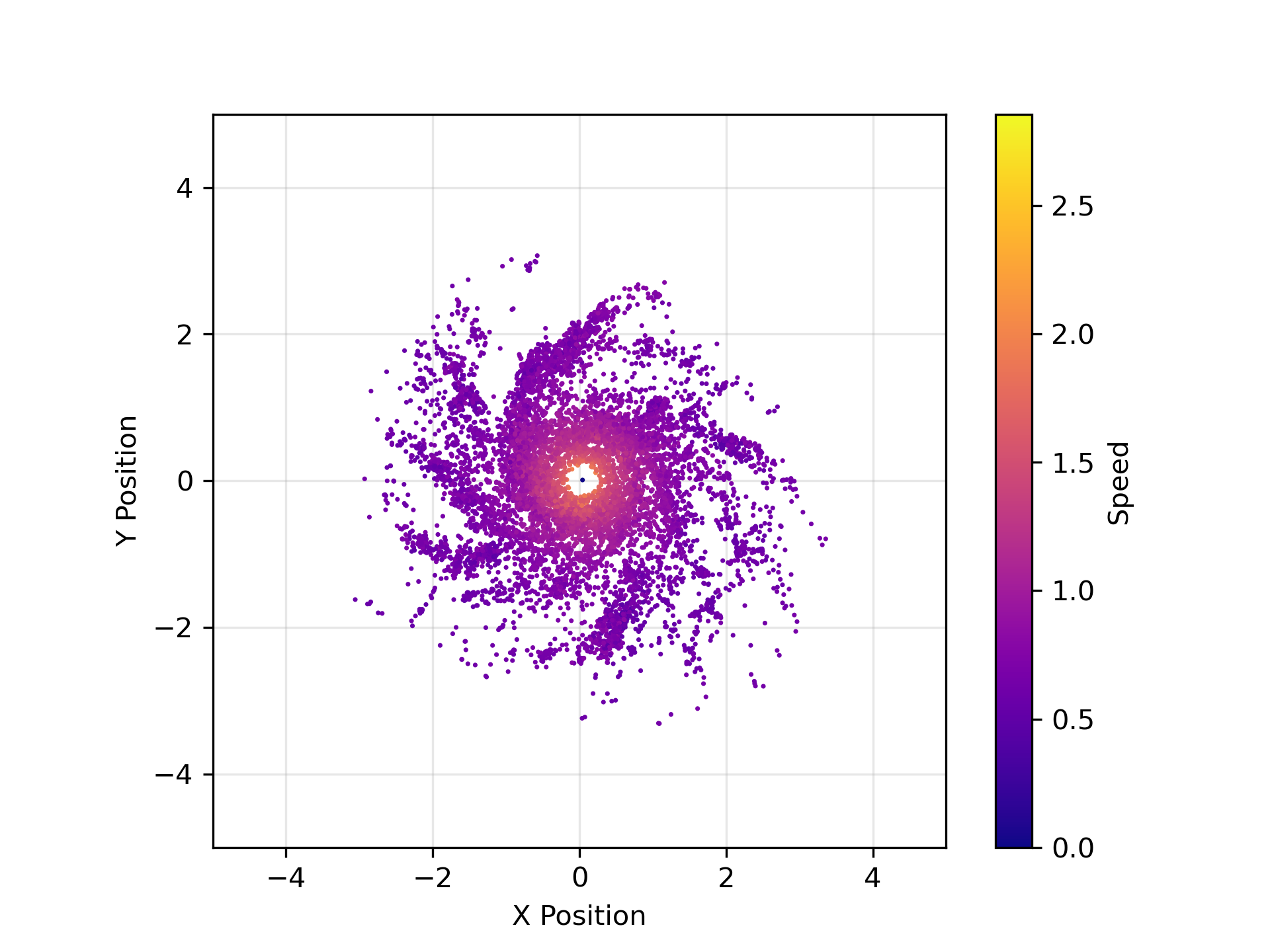
This is a simple N-body simulation implemented in Python using the Barnes-Hut algorithm for efficient force calculation. The project includes a Cython extension for performance optimization. The simulations can be visualized using Matplotlib.
Project Structure
nbody/: reusable simulation engine and Cython extensionexamples/: runnable scenarios (easy to extend with new setups)tools/: utilities such as state animation/exportoutputs/: generated simulation data
Quick Start
Build Cython extension:
python setup.py build_ext --inplace
Run examples:
python examples/spherical_collapse.py
python examples/galaxy.py
Animate saved states:
python tools/animate_states.py
See examples/README.md for guidance on adding more examples.
Features
- Simulating gravitational interactions between bodies in 2D and 3D.
- Implementing the Barnes-Hut algorithm for efficient N-body simulations.
- Visualizing the simulation results using Matplotlib.
- Optimizing performance with Cython for larger simulations.
Barnes-Hut Algorithm
The Barnes-Hut algorithm is a method for efficiently simulating the gravitational interactions between a large number of bodies. It works by dividing the simulation space into a hierarchical tree structure (octree in 3D, quadtree in 2D) and approximating the forces from distant bodies using their center of mass. This reduces the computational complexity from \(\mathcal{O}(N^2)\) to \(\mathcal{O}(N \log N)\), making it feasible to simulate larger systems.
Optimization with Cython
To further optimize the performance of the N-body simulation, we can switch from Python to Cython. Cython allows us to write C-like code in Python, which can be compiled to C for significantly faster execution. This is particularly beneficial for computationally intensive tasks like the Barnes-Hut algorithm, where the performance can be a bottleneck. By switching to Cython, I achieved a speedup of approximately 10x compared to the pure Python implementation, allowing for larger simulations and faster results.
Sources
More Projects